Invisalign Underbite Treatment: Can Aligners Fix Your Bite?
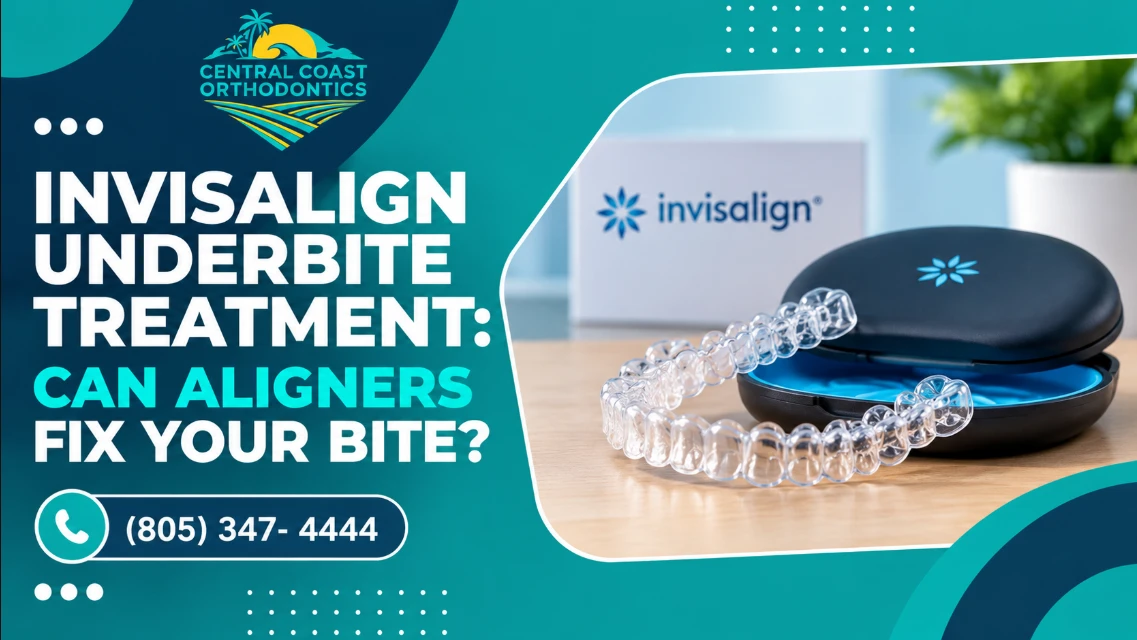
The reality is that aligners will work in most cases of underbites, but definitely not all. The effectiveness of underbite treatment using Invisalign hinges on whether the cause of the underbite is related to teeth positioning or jaw development. At Central Coast Orthodontics, we ascertain this fact before exploring the option of aligners. In this blog post, we will discuss what we look for, what the research says, and what other alternatives there are.

Meet Dr. Specht
Perfecting smiles for over 30 years with expert care and advanced technology.
15 Years of 5-Star Reviews • Virtual Visits Available
Dental vs. Skeletal
In orthodontic terms, an underbite is known as a Class III bite. All that means is that your lower teeth meet up in front of your upper teeth. But there are actually two completely different conditions that can cause an underbite.
A dental underbite is caused by the teeth. Perhaps your lower front teeth are tipped forward, while your upper front teeth are tipped backward. In either case, your jaws are relatively well-balanced. Since the problem occurs in your teeth, it can be fixed by adjusting the teeth.
But a skeletal underbite is a problem with your bones. Your lower jaw may have grown forward too much, your upper jaw may be positioned too far back, or both. It’s typically genetic. Therefore, simply straightening your teeth isn’t going to help.
It is also necessary to mention the third kind of Class III malocclusion. There are those who have pseudo-Class III malocclusion (also known as functional underbite). In their case, the teeth hit each other, and the lower jaw moves forward to allow the posterior teeth to be closed. This creates the impression of a more severe malocclusion than it actually is. According to research by the National Library of Medicine, such a condition can be corrected with only orthodontic treatment, while skeletal Class III in adults requires surgery.
In real life, many patients have a mix of dental and skeletal factors. That is exactly why the diagnosis always comes first.
How Invisalign Underbite Treatment Actually Works
Aligners do not force a jaw to move backward; rather, they gradually shift teeth until they fit perfectly into place. For an underbite, this normally involves a combination of three elements.
First, we make some extra space in the lower dental arch. We may gently shift the lower posterior teeth backwards sequentially in a process known as sequential distalization. In some instances, we also smooth out a fraction of a millimeter between the lower anterior teeth to make space. Second, small tooth-colored attachments provide support and guidance to the teeth through the aligners. Lastly, we apply Class III elastics, which are small rubber bands connected from the lower anterior to the upper posterior teeth.
And how much can this be done? In previously published case series for adults, the aligners moved the lower molars back by about 2 to 3 mm, which is sufficient to make the occlusion normal in appropriate cases (Padmanabhan et al., 2023). However, according to a review in the Journal of Orthodontic Science in 2024, the lower molars tend to tip back rather than translate back, so some overcorrection needs to be planned by the orthodontist.
Are You a Good Candidate for Clear Aligners for Underbite?
A photo or an online quiz can't answer this. Instead, we need all the necessary records. Usually during your appointment, we perform:
- An examination of the way your teeth fit together and the movement of your jaw as it moves forward when closing
- Taking a digital 3D scan and photographs of your face and smile
- X-rays, including a lateral one, to measure the relationship between your upper and lower jaws
- Checking the health of your gums and bones because your teeth require a healthy environment for moving
Clear aligners for underbite treatment are more suitable in cases where the malocclusion is mainly dental, mild to moderate, and the patient wears aligners about 22 hours per day. Indeed, a systematic review conducted in 2025 proved that the scientific evidence strongly supports aligners' use for the treatment of mild to moderate malocclusions. Consistency is also important. Elastics and aligners function only when they are worn.
When Another Underbite Correction Option Makes More Sense
We would rather be honest with you than mislead you into buying the wrong treatment. Here is what we might advise instead.
Children who are growing
For children, timing is crucial. According to the American Association of Orthodontists, the ideal time for the first orthodontic consultation is age 7 at the latest. Underbites are among the problems that could be helped by early treatment (AAO). If the jaws are still developing, we can use appliances like an expander or facemask to influence jaw development. Indeed, a 2024 Cochrane review of 29 studies (1,169 children aged 5 to 13 years) shows that these treatments have a significant effect on the bite in the short term. However, according to the authors, long-term data is still insufficient (Cochrane Oral Health).
Movements of the teeth are bigger
Sometimes the problem requires more control than aligners can provide. In this case, conventional braces, often used with mini-screws called TADs, might be a better option.
Adult cases of significant skeletal underbites
After the cessation of growth, the teeth can do so much to adjust. If there is an imbalance in the jaws, the most permanent solution would be to undergo orthodontic treatment in conjunction with jaw surgery. However, even after the procedure, orthodontics will still have to be done.
What You Can Expect During Treatment
Of course, each situation varies, and we’ll provide a personalized prediction after reviewing your files. Nevertheless, underbites generally require more time to treat than ordinary straightening cases. Mild to moderate cases usually take from one to two years, while complicated cases may take longer. On the way, expect some refinement stages, since scientific studies have proven that teeth sometimes don’t follow the digital model precisely at once. Finally, you’ll be asked to use retainers to stabilize your new bite.
Find Out What Your Bite Requires
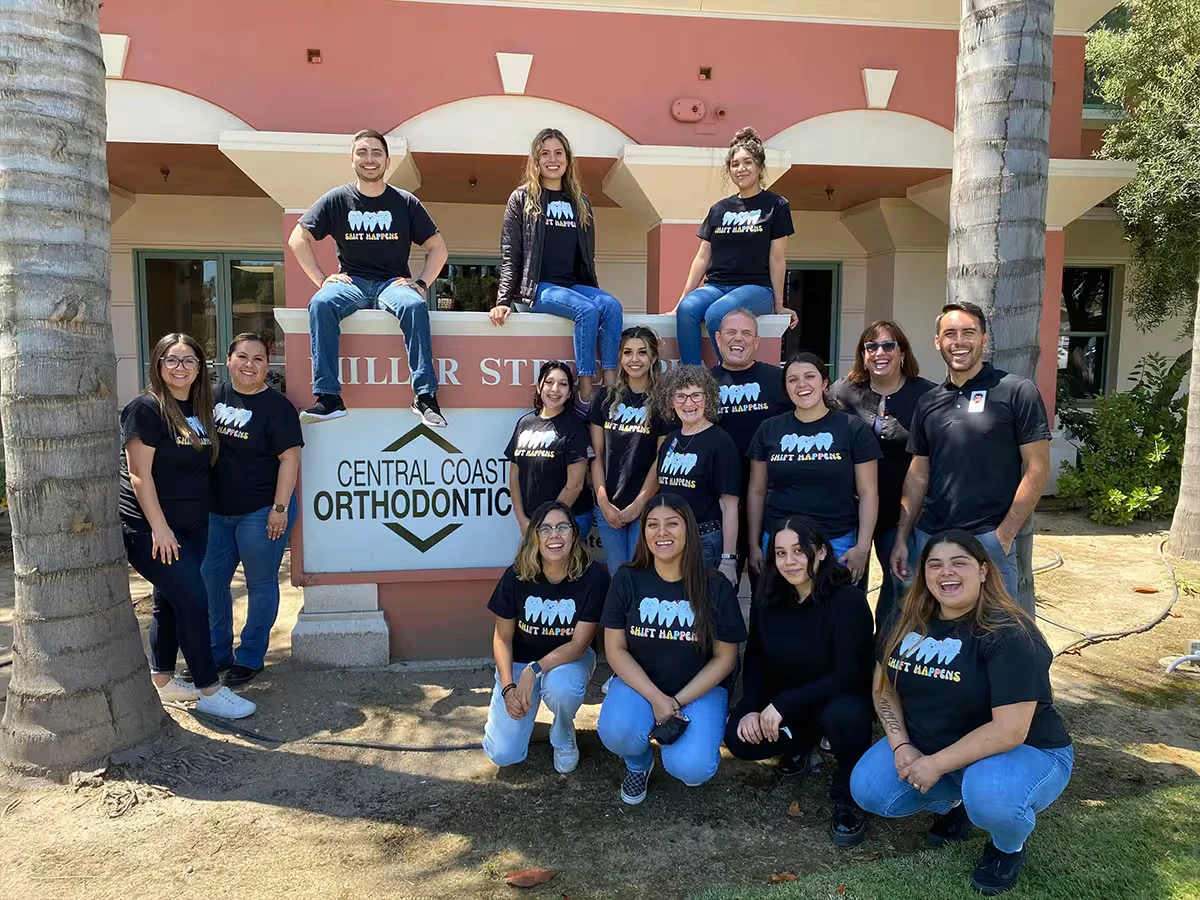
If you have been considering using Invisalign underbite treatment for yourself, the easiest thing to do would be to ask. At Central Coast Orthodontics, Dr. Kirk Specht and his team will examine your bite, will explain what type of problem you have – whether it’s dental, skeletal, or both, and will discuss all possible solutions for you, including those which don’t involve aligners.
Ready to learn more? Schedule your consultation with Central Coast Orthodontics today.
Related treatment
Curious about clear aligners? Learn how treatment works and what it includes with Invisalign in Santa Maria.
We Love What We Do
@Central Coast Orthodontics Stay connected with us through social media and see how we're making people smile every day!



Get Started On Your New Smile Today
Experience 5-Star Care
We get results, plain and simple. Check out some of our awesome 5-star reviews from happy patients over the years!
Specialists in Orthodontics
1400+ 5 Star Google reviews and counting